Emilia Romagna is a lesser known province of Italy for travelers, but is consider the epicenter of gourmet Italian food. Parmigiano-Reggiano, balsamic vinegar, prosciutto di Parma, tortellini, spaghetti alla bolognese…the list goes on and on. Thus, there was no question we had to at least pay quick homage to this Italian food Mecca as we drove from Tuscany to the Cinque Terre.
We stopped in Parma and Modena, trying to sample as much as possible in the little time we had. We definitely need to go back for more culinary tours (including of Parmigiano-Reggiano production, which we couldn’t squeeze in. I know…I should retire my hat and the name of this blog). But we did learn about how one of the oldest and most revered condiments is produced: traditional balsamic vinegar of Modena.
Balsamic vinegar: Serious business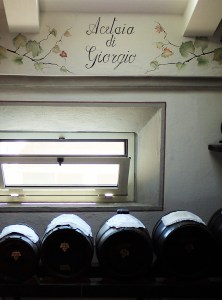
Traditional balsamic vinegar (Aceto Balsamico Tradizionale, which I’ll just refer to as balsamic vinegar) has been around for 1,000 years and it is highly regulated to protect the traditional production methods and distinguish it from other vinegar.
The label must say: “Aceto Balsamico Tradizionale, DOP.” The DOP stands for “Denominazione di origine protetta” or “Protected Designation of Origin.” It must be made the traditional method, be free from any additives, and be aged a minimum of 12 years. It can only come from Modena or Reggio Emilia. The “Consortium” regulates everything — honestly, the reverence with which our Marcello kept saying “the Consortium” sounded like gangsters refereed to the “Correlone family” in the Godfather movies.
Touring Acetaia di Giorgio
We visited the Giovanna and Carlotta Barbieri, whose family has been producing traditional balsamic vinegar in Modena for over a century. They live in a huge, beautiful home that used to be on the rural outskirts of Modena, but it’s now in a more industrial area a few kilometers from the old center. Marcello was our wonderful teacher.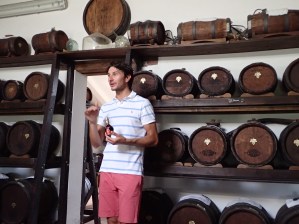
The first thing you notice when you enter is the overwhelming sweet smell of balsamic vinegar filling your lungs. The house smelled of vinegar because traditional balsamic vinegar is aged in attics because hot summers help the fermentation and acetification process, and cold winters allows the vinegar time to rest and age.
Our tour took place in the actual attic, surrounded by barrels of vinegar — I can’t even imagine how much money was up in all those rooms.
Producing balsamic vinegar: A lesson in patience
Balsamic vinegar traditional comes from Trebbiano and Lambrusco grapes – the juice is processed, reduced through cooking (it’s not spoiled wine!), and then aged…and aged…and aged. There are no additives or chemicals to hasten the process — it’s all the natural yeast in the air. The aging process takes place in an assembly line of wooden barrels that are lined up, largest to smallest, that reminded me of the Russian stacking dolls. The smallest holds the vinegar that’s about to be ready for bottling, and the largest is the new batch. The vinegar is rotated down through each barrel, but about half is left in the previous barrel so the vinegar at each stage has vinegar added to it that is more aged and so there is always a “starter” vinegar in the first barrel and the taste is consistent in every batch. The barrel’s whole is covered only by a lace doily so the vinegar can breathe.


Approval by the Godfather: DOP Designation
When the vinegar is ready, the producer brings it to official tasters of the Consortuim (that mafia style group) to approve the flavor. The producer is not allowed to bottle the vinegar – it must be bottled in a controlled location to keep the product tightly regulated. Balsamic vinegar is all bottled in the same cute little bottle and only at 100 ml – no more, no less, which helps consumers to identify the real thing.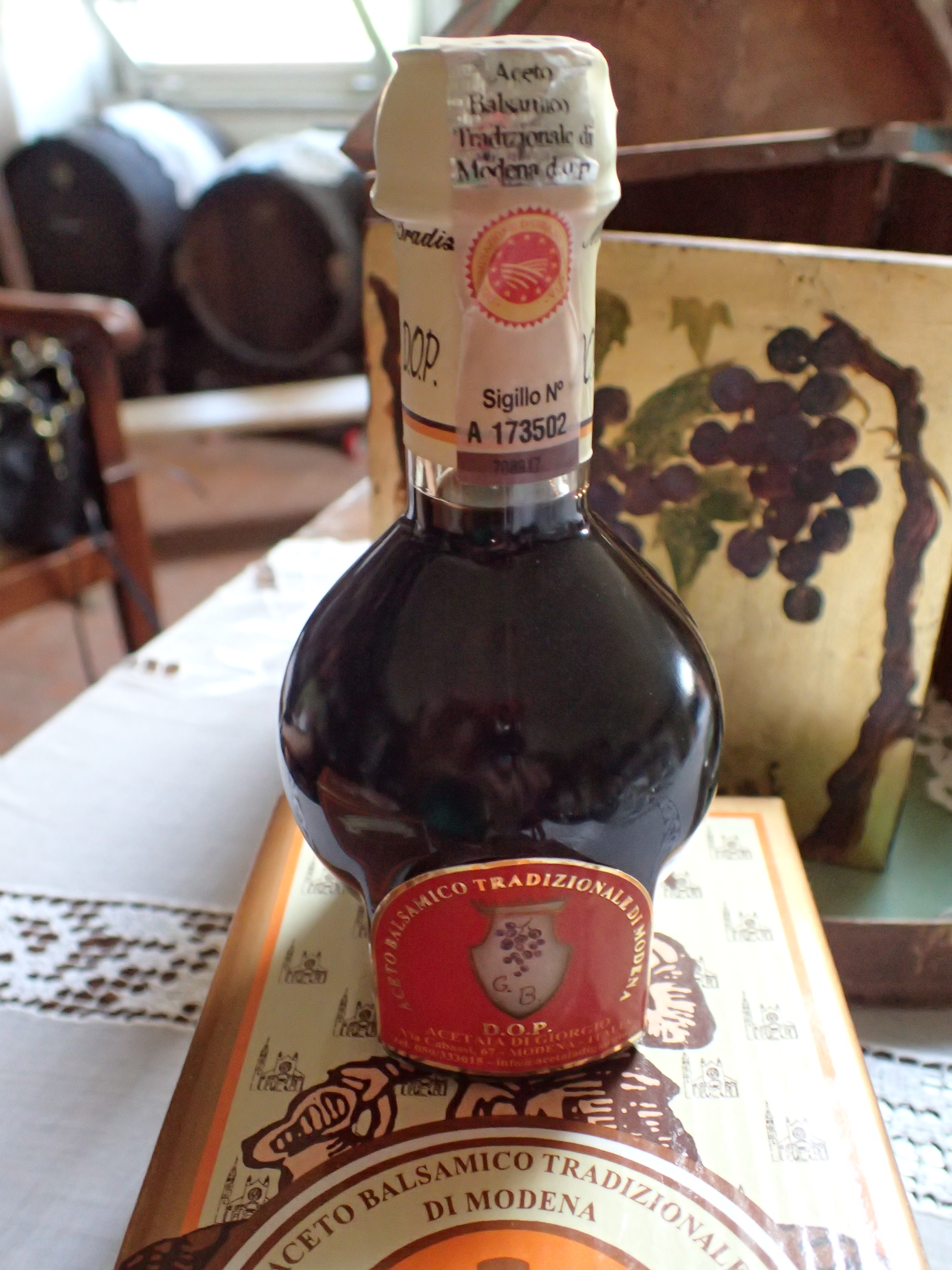
Our teacher Marcello noted that all balsamic vinegar tastes pretty much the same. Producers can really only differentiate their product by the type of wood it is aged in or the length of the aging process. We tried a variety of vinegars from different wood and different ages. They were really good, and the more aged was even better. If you love balsamic vinegar, then it is definitely worth the price. Real balsamic vinegar can never go bad, so you can hold onto it for a long time. And at a minimum of about 60 Euros for 100 ml (more for longer aged), you may really, really hold on to it! But it’s still a great bargain compared to buying it outside of Modena.
It was a really interesting and educational tour. I highly recommend you stop by Acetaia di Giorgio if you’re going through Modena! Grazie mille!


MORE POSTS ON ITALY
Check out my travel page for more posts and travel tips and laughs about Italy.
 Travels with Cheese
I too wrote a post on Balsamic Vinegar from Modena recently 🙂 I have just recently shifted to Wordprress from Blogger and loving it.. Hoping everything falls in place soon. #IloveItaly
LikeLike
Same here! Love WordPress and Italy! Best to you and thank you for reading.
LikeLiked by 1 person
Thank you so much!
LikeLike