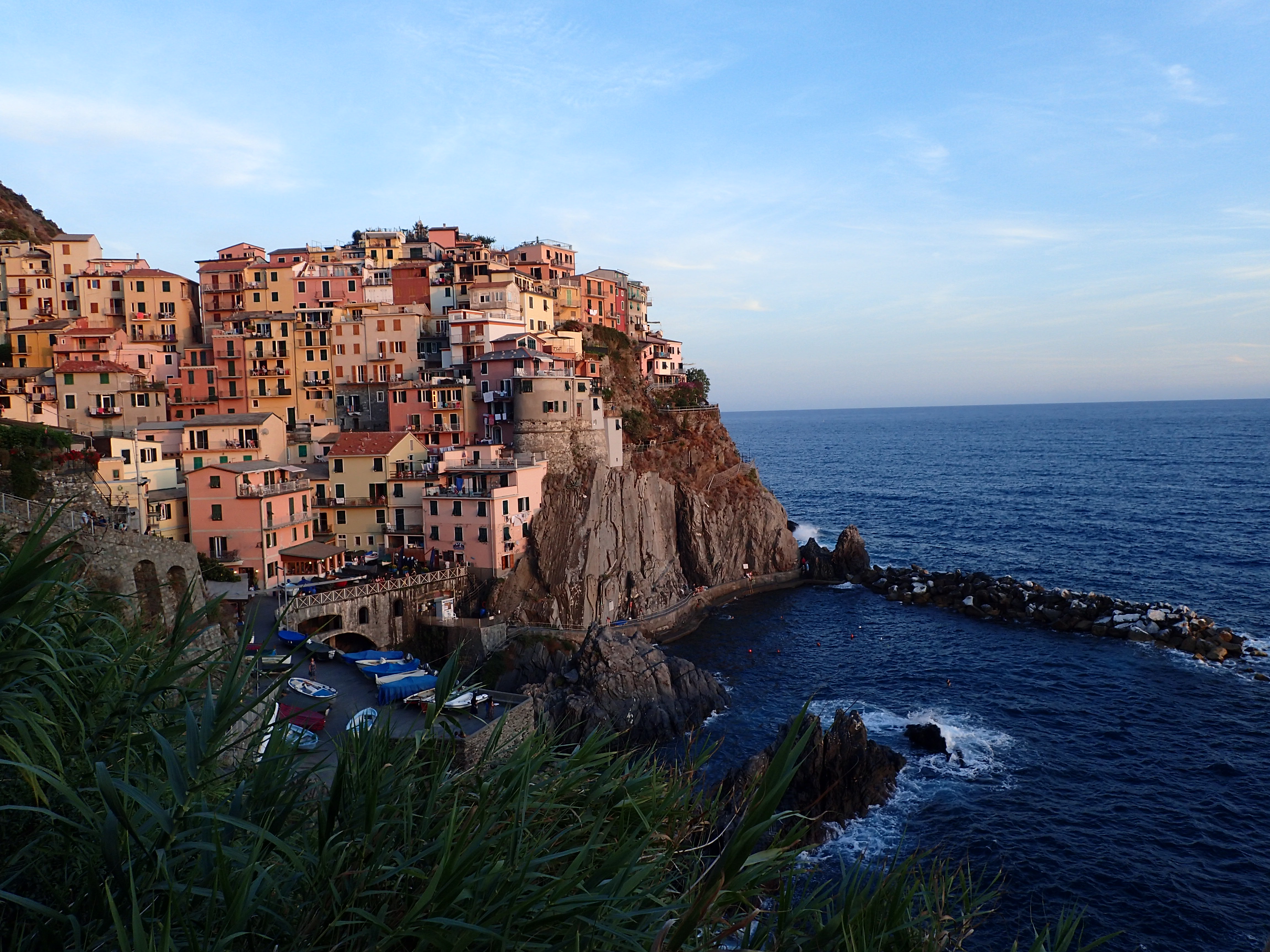
 The first image most Americans have of the Italian coast is at the “fancy” pizza place – you know, the one with the back seating area and paper place mats, with the murals on the wall. When you weren’t burning the roof of your mouth with hot cheese, you were probably staring at the mural, which was probably of southern Italy, probably the Amalfi Coast since most Italian-Americans migrated from the area south of Naples. That type of landscape seems unreal, you think: the colors, the water, the cliffs. Silly Italians, you muttered, as you try to stop the cheese from falling off your slice.
And then when you travel to Italy, you realize how badly life must have been for anyone to ever emigrate. I could put up with a lot of poverty and corruption for the food and scenery of the Italian coast. The two famous parts of the coast are the Amalfi Coast to the south and the Italian Riviera to the north. I’ve been fortunate to have been to both and both are ridiculously beautiful, but on this trip I got to revisit the Cinque Terre in the Italian Riveria. It seems otherworldly, and when I’m there, I briefly feel like a girl in a fairy tale who was whisked away to a mystical, mysterious land.
Brief Background on the Five Lands
The Cinque Terre — “the Five Lands” — are five small villages on the northern Italian coast in the province of Liguria. They are part of the Italian Riveria, but less fancy-pants than Portofino to the north and quainter than the work-a-day port of Le Spezia to the south. They sit atop rocky ledges with dramatic drops to the sparkling, blue Mediterranean. The only view from each town is the sea and the meandering shoreline. It stays so wild and pristine because the whole region is a national park and a UNESCO World Heritage site.
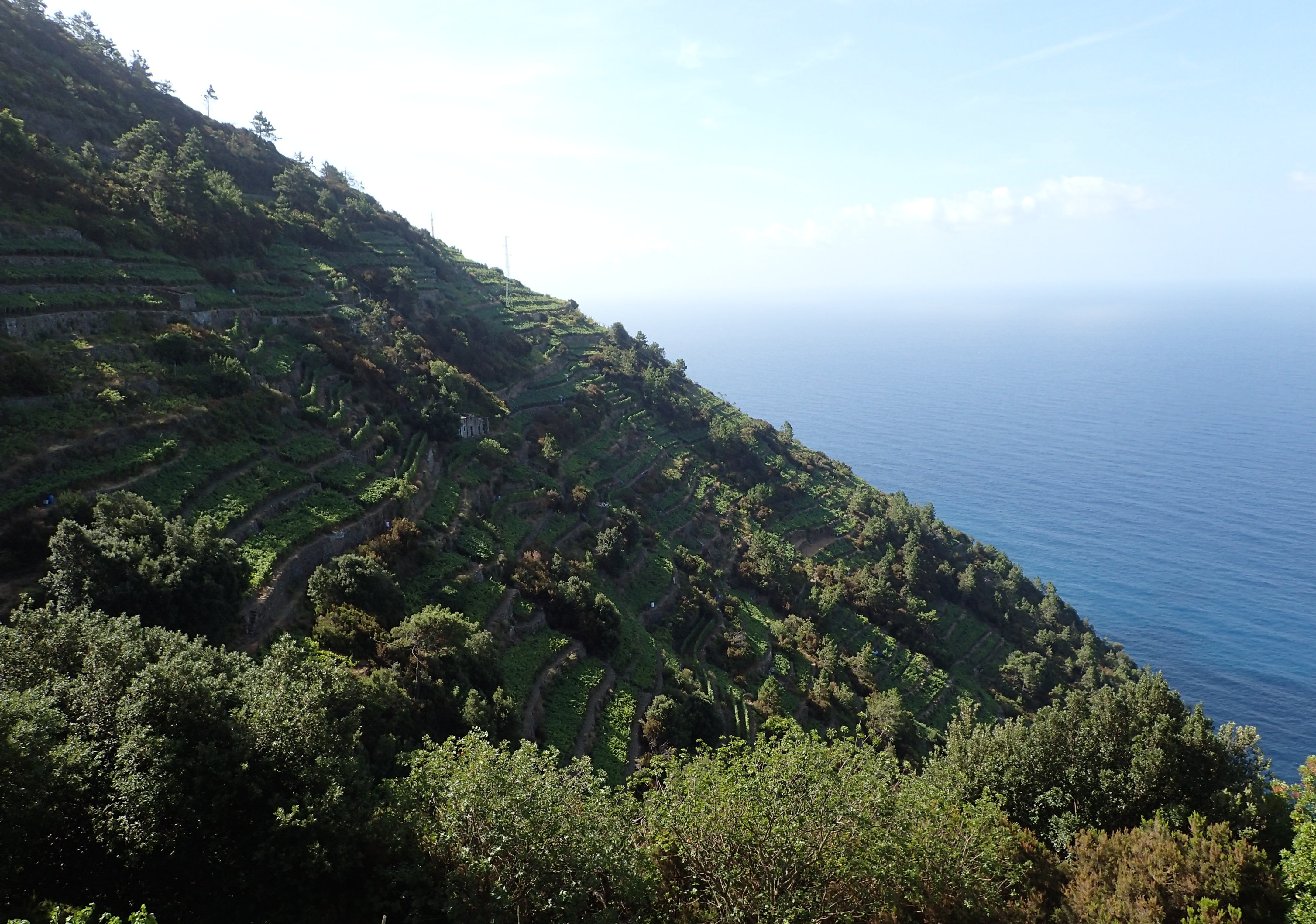 People have lived in the Cinque Terre for more than a thousand years (maybe even the Bronze age). They remained isolated from the rest of the mainland due to the mountainous terrain. The inhabitants relied on fishing (and dodging pirates attacks) and cultivating wine by building vineyards into the sides of the mountains. Italian unification in the 1870 spurred rail lines to connect the villages to the rest of Italy, and the highway road was finished in the 1960s, which further brought the towns out of isolation. Their popularity with tourists started to expand in the 1970s. A 2011 flash flood buried the towns of Vernazza and Monterosso under mud so high that second story balconies were on the street level. The towns recovered, but it’s worth learning about the devastation to appreciate how much they’ve gone through and admire how quickly they’ve recovered.
Quick Overview of the Towns
Riomaggiore is the southern village and the second most substantial in terms of stores and restaurants. There’s a Nazi bunker and a little harbor, and the requisite pink houses leading down to the water and some rocky sea access.
Manarola is next and a bit quainter and quieter than Riomaggiore. Everything is huddled near the harbor, which is the only deep water swimming area (read: jumping off rocks) of the five villages. We stayed here, so more later.
Corniglia is the middle village and the only one without direct access to the water, as it sits high up in the mountain on a cliff. They are famous for their wine and being a very peaceful town.
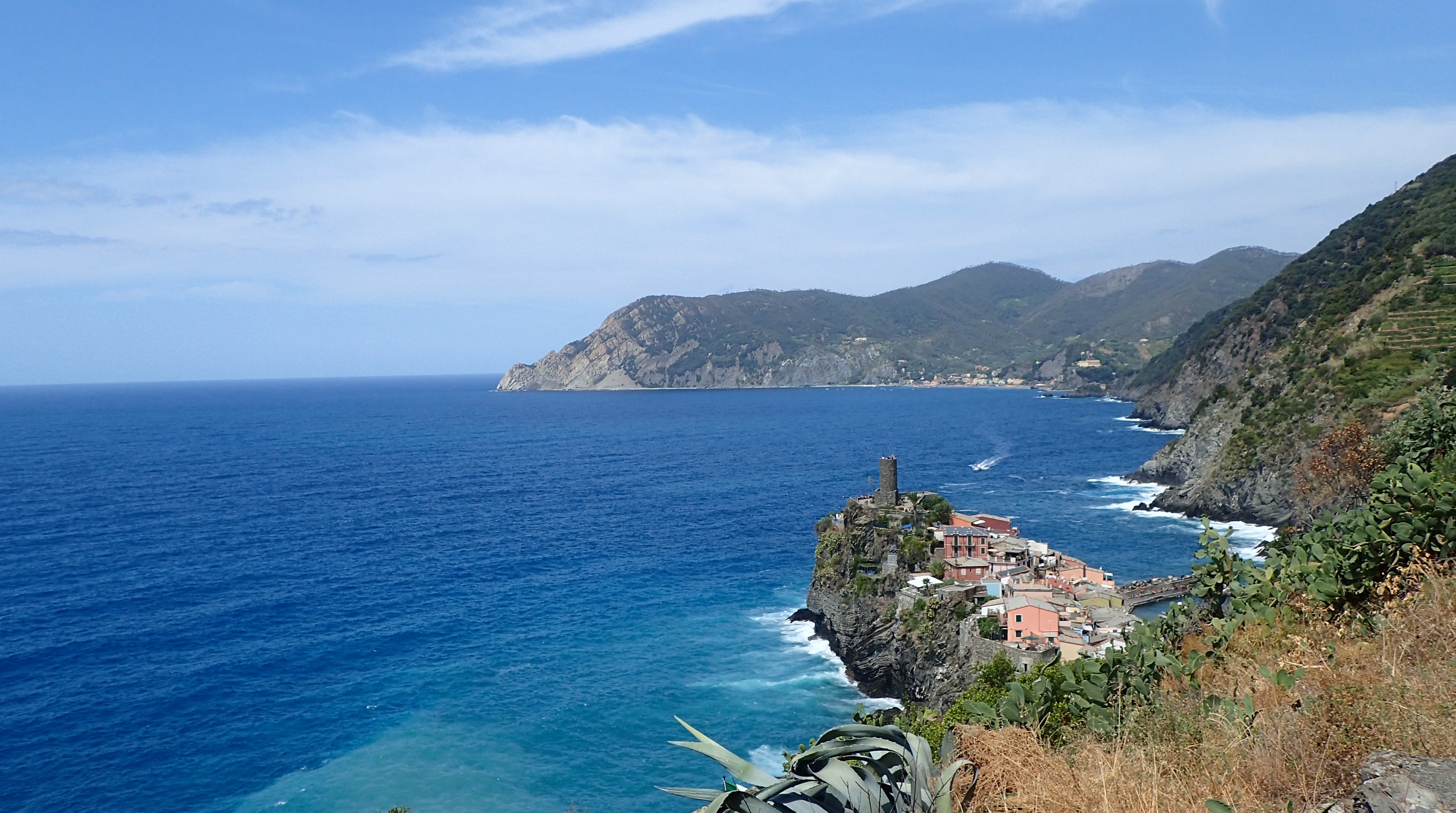
Vernazza has the most proper and picturesque harbor and a few more stores and restaurants Manarola. It has a lovely tower. I’ve stayed there before and it’s a beautiful town and a convenient base.
Monterosso is the northernmost town and probably what you imagine when you hear “Italian Riviera.” It has a long sandy beach with some free areas, but most spots require chair/umbrella rental and fill up quickly in the summer. The old town is quaint-ish and the new town is bustling. It’s popular with a younger crowd who like buckets of beer and a hopping night life.
Sunset Magic
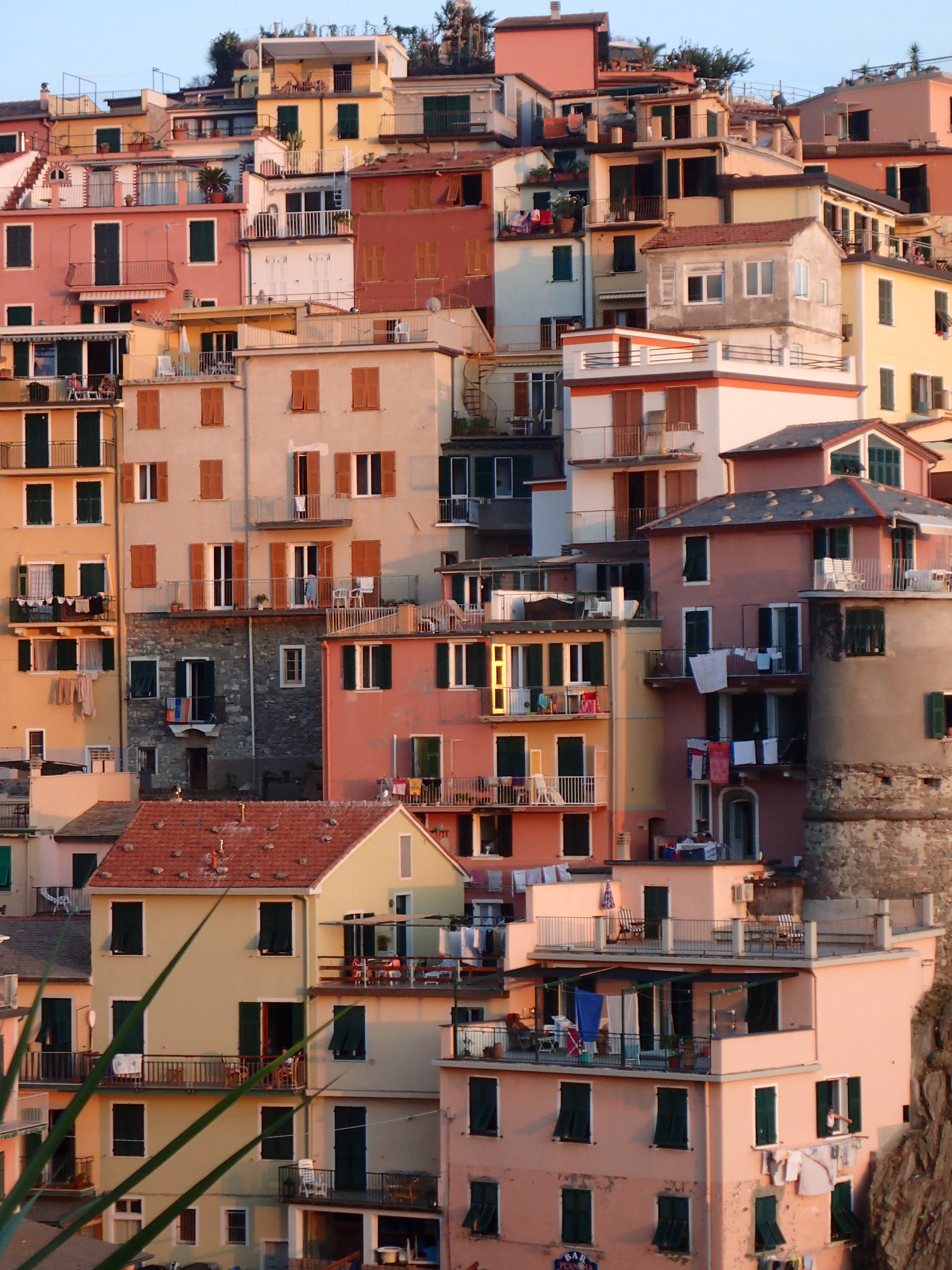
The towns change at sunset. The tourist buses depart, the streets empty, shuffling old locals bring their shuffling dogs for a stroll. Through the soft rays of the setting sun, you can see what it would have been like to be in the undiscovered Cinque Terre: Old and young slowly meandering along the twisty stone streets, couples dangling their toes in the water and leaning their foreheads intimately close, and fisherman bringing to shore their tiny, pastel boats that seem to be a reflection of their tiny, pastel houses overhead.
Each night at sunset we climbed above the harbor to Nessun Dorma, which sit atop a cliff overlooking Manarola. It was the perfect perch to sit with a drink and watch the houses turn from bright to muted pastels and then glimmer against the black night sky. The food is snacky (e.g., bruschetta) and just average, so save your belly space for dinner and just get a drink. We easily got great seats along the edge when we showed up about 7:30. The music can be a little odd for the setting (Macklemore?) but it’s easy to tune out every distraction except the crashing waves and seagulls’ evening cries.


Hiking
There are many trails in the mountains behind the Cinque Terre. You can go even a bit higher and more remote — that’s for the serious hikers, which isn’t me yet since I’m not prepared to pull a 127 Hours. The Germans and Austrians will be all over those trails — you can spot them by their walking sticks. A good rule: Always keep an Austrian in site because (1) they always know where they’re going, and (2) You can to pretend that your the family von Trapp escaping into Switzerland.
Hiking Part 1: Manarola to Riomaggiore (and back)
I was determined to hike all the villages as a kind of victory/celebration commemorating three months post-ACL surgery (Have you met Brenda, my new ACL?). I’ve done a bit of hiking there before, but I never did the full trail linking the five towns.
The first day, after a quick swim (see below), we got a basic trail map from the local tourist info center and headed out. But first we had to stop at the trekking store because my boyfriend forgot socks and mine were itching me. The lady looked very concerned that we were trekking yet didn’t even have the basics like socks down. “Arrogant Americans,” she must have thought. “Whatevs, we took Normandy,” the arrogant Americans thought back.
 Many of the trails are still closed from the 2011 flood. Well, technically closed. We didn’t quite know that because it didn’t say on the map or on the trail markers, so the first day we found the trail from Manarola to Riomaggiore (trail #531) and started climbing – er, scrambling – up. And up. And up. It’s not a long trail, but it’s a very steep ascent and then descent over an unkempt (i.e., closed) trail with shaky rocks and falling dirt. The roughness of the trail should have been a clue, but whenever I see something a little rough overseas, I just think that Americans are used to overly sanitized and safe conditions so I just shrug. When I got to the top, I was a weeeee bit sweaty, as you can see.
We got to Riomaggiore and grabbed some nutritious hiking fuel — gelato — and looked around the harbor. And then I said, “So, we could take the train, but really – it’s not that long of a hike. By the time we wait for the train, we could be home.” My boyfriend just gave me a look and said, “Yup. Okay.” Our relationship is a bit of a constant competition to not be the one who wimps out, so when one of us throws down the gauntlet, the other basically has to accept. So up we went. The return felt harder for me but easier for him (or so he says).
Hiking Day 2: Manarola to Corniglia to Vernazza to Monterosso
We got up early and surprisingly felt great, even my knee. So up…and up…and up we went again, this time towards Corniglia on another technically closed trail (#586 to #587). The first part was a bit of a brutal climb through vineyards with step ledges that took effort — I think my hands got as dirty as my legs from having to reach down like a mountain lion for balance and leverage.
We finally got to the in-between village of Volastra — tiny, pristine, and quiet (a shuttle van goes from Volastra to Manarola if you wanted to stay far from the maddening crowds). We filled up our water bottles and then started the rest of the hike to Corniglia, which was a bit better as we were already pretty high up, so the trail meandered through the woods as we went between the mountain peaks. It took about 2-2.5 hours to go from Manarola to Corniglia (via Volastra). About 20 minutes from reaching Corniglia, one girl with flip flops going up the mountain painfully asked us, “Is it far?” I bit my lip and replied, “Um…is two hours far?” God bless her, she kept going. I assume she’s still walking.


At Corniglia, we once again filled up our water bottles at the public fountain and found the open trail to Vernazza (SVA). We actually only then realized the difference between open and closed trails because (1) a couple looked shocked when we said we came from Manarola on our way to Monterosso, and (2) we finally had to buy the trekking pass at the entrance to the trail to Vernazza. So “closed” essentially means that you don’t have to pay to potentially kill yourself. It took probably 1.5 hours to get to Vernazza, where we had more trekking food — gelato (I love the fig and sweet cream flavor at Gelateria Vernazza) — and more water. And then…one more hike to Monterosso (#SVA). It was probably the easiest hike, but we were pretty tired and hot.


We made a beeline for a focaccia and beer lunch and then waited for the train…during which I had more focaccia. When the train arrived in Manarola, I practically pushed a baby over to get to harbor to swim (we had towels and our bathing suits with us). It was the perfect, fun, cooling reward for our five hour hike.


Note on Trail Markers
Whenever you see a distance posted along an Italian trail, just multiply it by 10 or so, e.g., consider 0.4 km to translate to 4 km. I have no idea how they are measuring — as the crow flies? to the technical town line? — but it is useless for hiking. We’re fit and know how to measure distances in kilometers from running and hiked for 7+hours total, so I’m pretty confident in my assertion that the Italians are all playing a huge joke on foreigners hiking their trails. Good one, guys. Very funny.

Note to Germanic and Scandinavian Hikers*
Please, just try to be polite. Pretend even. I know you guys are killing it in Europe. You are the bankers to Europe, you’ve got cleanest countries, most organized countries, best healthcare, blah blah blah. You’re the tops. Congrats.
But being awesome doesn’t mean you don’t have to be polite. Here are two simple things you can do while hiking:
1) Say “thank you” when someone lets you pass.
2) Say “thank you” in the local language. I know English is the new lingua franca, and yes, I know there were tons of Americans in those mountains. But everyone who is in Italy should be able to master a few basic phrases, like “Grazie” for “Thank you,” and “Prego” for “You’re welcome/Please. There should be a test at passport control before they let you into Italy.
We were a bit ticked off by the number of times we didn’t get a “Thank you” let alone a “Grazie.” So every time we let someone pass and they didn’t say “Grazie” we said “Prego” anyway, just to make the point. And if someone did say “Thank you” we still answered “Prego” because come on, folks. We’re in Italy.
Passive-aggressive politeness. Pass it on.
(*Applies to Americans, too)
Swimming
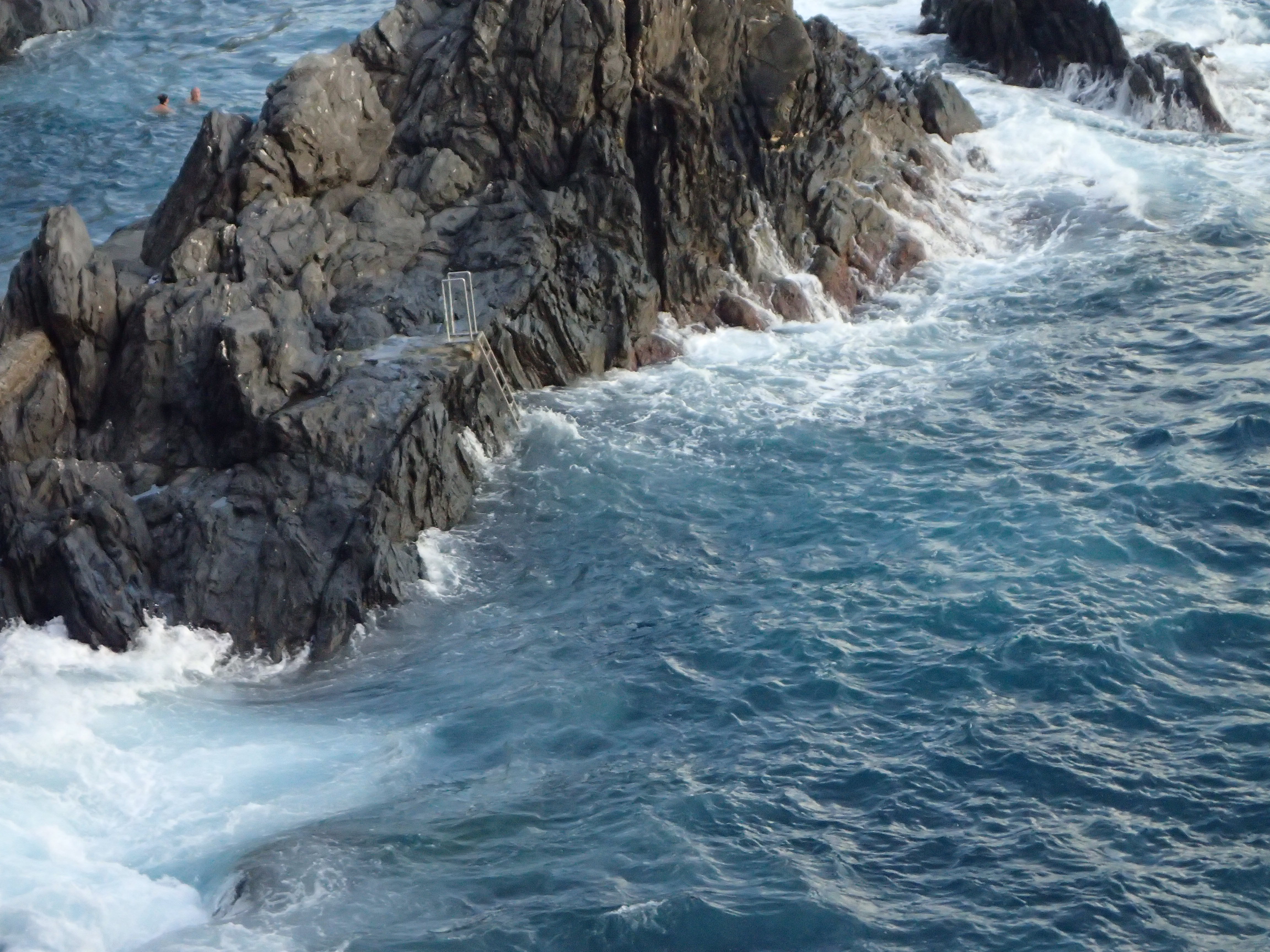
We chose Manarola primarily because it has a deep harbor with deep water swimming. The ocean was pretty tumultuous during our visit, which made it fun to bob in the water but a bit scary to jump in. The
waves were huge and rolled into the rocks, elevating the water by 10 feet, before steeply dropping. The first day we just jumped in, getting braver each time. I was determined to dive – especially as only the guys were doing it, and my feminism comes out in full force whenever it seems girls are too scared or not athletic enough to keep up. And so on the second day, for about 2 hours the second day, I was diving (or even jumping) in. I kept singing “Anything You Can Do” from Annie Get Your Gun: “Anything you can do, I can do better. I can do anything better than you.”


Eats
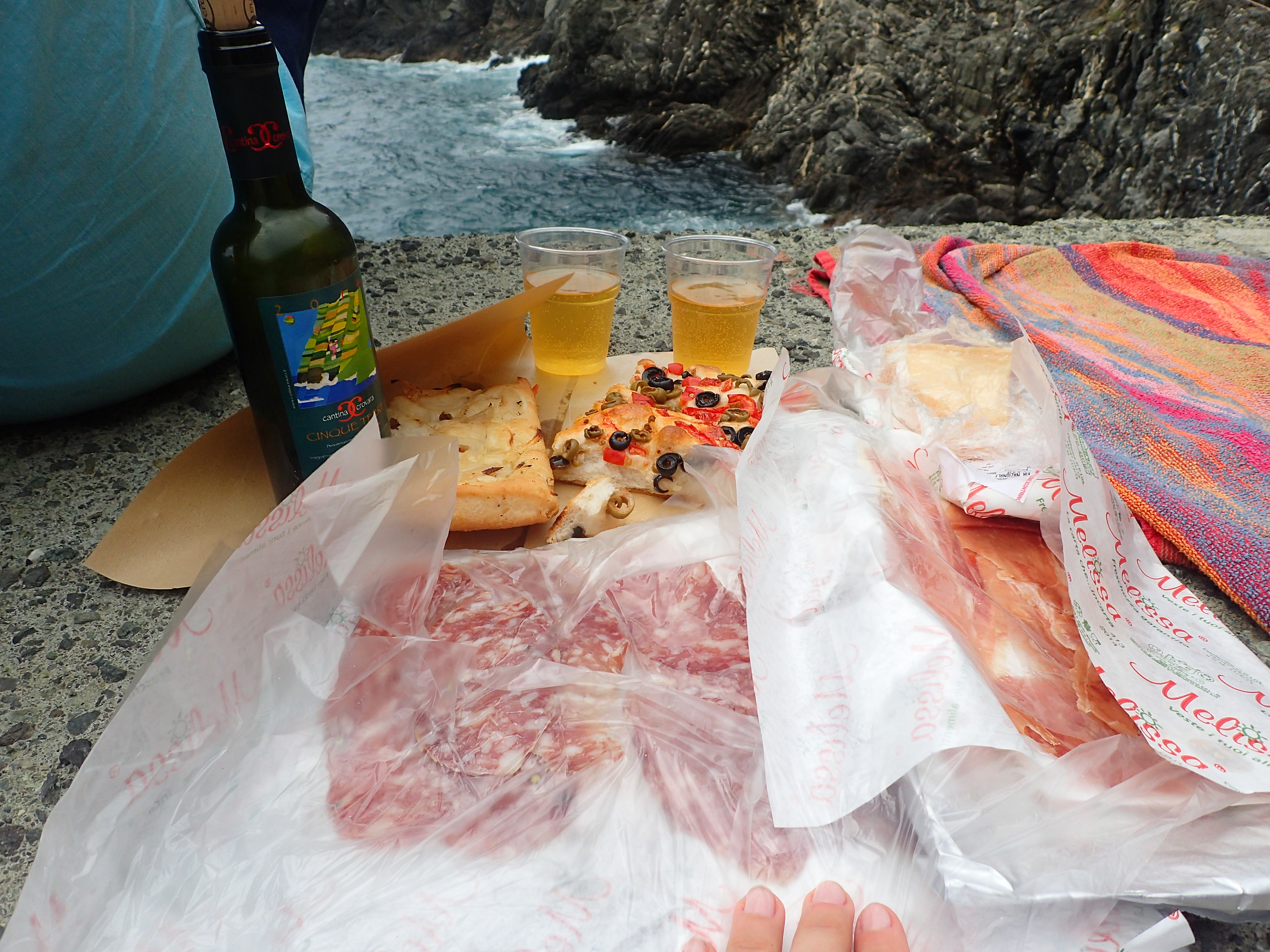 Liguria is known for two of the most mouth-watering foods of Italy: pesto and focaccia. When done poorly, both are supreme disappointments – tasteless, oily pesto and dry, dense bread. But when done well, there’s nothing that comes close.
Like most Italian food, pesto is a basic recipe that relies on having the freshest ingredients: basil leaves, pine nuts, Parmesan, and olive oil. Purists say it must be made with a mortar and pestle to not overly bruise the basil leaves. Focaccia is a light, airy, buttery/oily bread that can be eaten plan or topped with pesto, cheese, tomato – anything you want. The best way to describe the seductive bread it is that it has that airy, buttery taste of the crust of a Pizza Hut pan pizza. I know! Sorry. I haven’t had Pizza Hut in literally 20 years, but that’s the closest analogy – and damn that crust was good. Every focacceria has their own version. The best I’ve found in the US was in San Francisco (described in my post on San Francisco foods).
Cinque Terre has it’s own wine, of which it is really proud. Have you ever heard of it? No, right? I think that’s because it’s not very good. No one would pay to have it shipped to the US. But they are so proud of it, and it’s perfectly okay, so order a liter with dinner because when in Rome. Warning: I tried to order a Chianti one night, and it was so bad that I had to send it back. It must have been open for a long time or they were punishing me for ordering another region’s wine.
The first night we dropped into Cantina dello Zio Bramante, a little tavern with basic food and a live local band with a harmonic player that totally looked like he was in the cast of the Jersey Shore. Part blues, part jazz, these talented musicians entertained us as we slowly drank some local liter of white wine. I didn’t see a kitchen, which is always suspicious if a place is serving hot items, so I stuck to gorging myself on crostini with pesto and a cheese platter. My boyfriend also played it safe and and order trofie with pesto. Trofie is a traditional small, tubular pasta from the region that has the perfect rough texture for pesto to cling to. We finally went home about 10:30, knowing we had an early morning and long hike ahead of us.


The next night we went to Trattoria Il Porticciolo in the middle of town. It has a decent, not-too-touristy menu. My boyfriend ordered the anchovy platter – anchovies cooked about 4 different ways. The fried was pretty good for fish — not oily, clean tasting, and fresh like the ocean. He also got the squid ink pasta, another local specialty. He said he really liked them both, but I saw him eyeing my charcuterie platter.


Lodging
We rented a room from Davide Rooms, who has a few rooms right in the center of village near the harbor and not too many stairs to climb with luggage. The room was basic and clean with tiled floors and a private bath – just what we needed given we planned to spend very little time in it. Your best bet in these smaller towns is to rent a room from someone like Davide – it’s a pretty efficient operation and very common.
To reach our building, you ducked up a narrow, almost hidden staircase off the main street. The old stone staircase was protected by stone buildings that seemed to lean in on you a bit. Atop a flight of stairs was a little opening, onto which different doors opened and yet another secret passage way extended. Laundry hung overhead from the different windows. There were always a group of four elderly men and women sitting outside our building, and I always said the appropriate hello to them in Italian, and I think by the end I managed to get a gruff sound out of one of them.
Transportation Notes
You can’t park in the towns – the only lots are small and above each village. Plus, the roads aren’t fun to drive if you don’t have good nerves and are experienced in how to handle blind turns with one lane both ways. Train is the way to go if you aren’t driving. If you are driving, like we did, just park your car in the lot above your town and remember to leave it empty to prevent thefts (though it seemed generally safe). Follow Rick Steves’s guidelines for train travel.
 Memories
The Cinque Terre is a magical place. The colors, the water, the hills, the houses — none of it seems real. It all seems like a page out of a fairy tale, and that’s what so special about these Five Lands: While you are there, the rest of the world is seems to have disappeared, time seems to stop, your pulse slows down, your senses become overloaded with sights and smells you didn’t know could exist, and for a few days you are full of the delight and wonder of a child first experiencing something that they think is part-magic.
“A long time ago, in a land far away, and girl traveled to a magically place known as the Five Lands…”
 Travels with Cheese
[…] very, very choppy with huge swells, which we knew from our time swimming in the Cinque Terre (see my post about our time there and how to best play in the […]
LikeLike